
Senior Correspondent
NewsBits.in
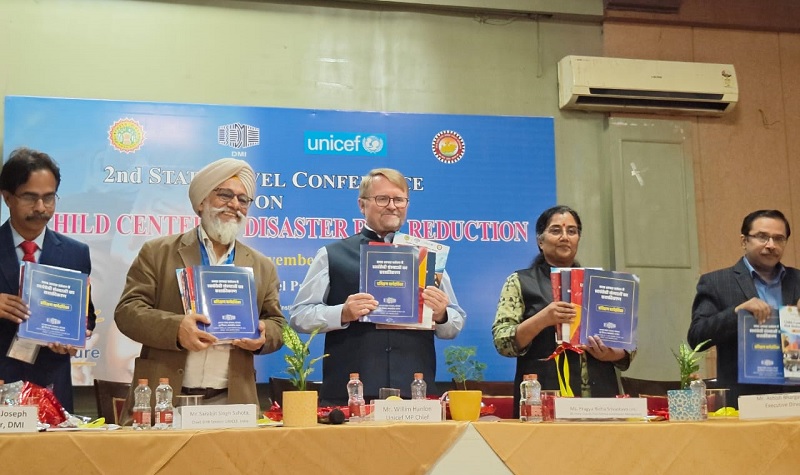
BHOPAL: The Disaster Management Institute (DMI), Bhopal, in partnership with UNICEF Madhya Pradesh and the Madhya Pradesh State Disaster Management Authority (MPSDMA), organised the second state-level conference on Child-Centered Disaster Risk Reduction (CCDRR) in Bhopal on November 23.
The conference brought together government departments, disaster management experts, health and child protection professionals, civil society representatives and young advocates to strengthen disaster preparedness and response with children at the center.
The conference highlighted the importance of integrating children's needs and rights into disaster risk reduction, preparedness, response and recovery, recognising that children are disproportionately affected by emergencies and require focused attention and protection, a media note said.
“During disasters, children suffer first and recover last. They must therefore be at the center of disaster preparedness, response and recovery efforts, with the attention and protection they need,” said Ashish Bhargava, IAS, Executive Director of DMI.
Emphasising the need for proactive preparedness, Dr. George V. Joseph, Joint Director, DMI, said “Prevention, preparedness and readiness for response are the need of the hour to ensure every child is protected before, during and after an emergency. Investing in children's safety is an investment in Madhya Pradesh's future and resilience.”
Sarabjit Singh Sahota, DRR Specialist, UNICEF India, stressed the importance of mainstreaming disaster risk reduction across sectors, noting that "Disaster management is a cycle that can be adapted to every field. For children, development must incorporate disaster risk reduction, and preparedness needs to be continuous across all settings."
Calling for collective action, William Hanlon, Chief of Field Office, UNICEF Madhya Pradesh, said that disasters disrupt children's access to education, nutrition, clean water, sanitation and safe environments. He emphasised "We need all sectors and communities to work together to protect essential services and move from deliberation to implementation for a greener, more resilient future for children."
The conference also highlighted the importance of community sensitisation, dignified rescue and inclusive rehabilitation. Pragya Richa Shrivastava, IPS, DG Home Guards, Civil Defence and Disaster Management, emphasised that "Child-centered disaster risk reduction begins with awareness and sensitisation, so it is increasingly essential that rescue and rehabilitation efforts respond to the needs of vulnerable groups with dignity."
Speaking on children's participation in disaster risk reduction, Anil Gulati, Communication Specialist and DRR Focal Point, UNICEF Madhya Pradesh, said, “Children and young people can be effective change makers. If we want them to be involved in disaster risk reduction, we must give them platforms to voice their opinions and concerns. Better preparedness can protect children while preventing long-term disruptions to their education and essential services.”
Gauranshi Sharma, UNICEF India's first Youth Advocate, called for equal opportunities and inclusion for children with disabilities, emphasising that every child should be supported to explore their aspirations, participate meaningfully and have access to opportunities without discrimination.
Dr Kripa Shankar Choubey, Member, Juvenile Justice Board, Bhopal, stressed that children's rights must remain protected even during calamities and that children should be informed about risks and empowered to seek help when they find themselves in vulnerable situations.
The conference also featured the release of DMI publications comprising compiled reports and codes, reinforcing efforts to strengthen disaster management knowledge and institutional preparedness in the state.
Highlighting child-centred approaches to health and nutrition in emergencies, Dr. Prabhakar Tiwari, Senior Joint Director, Child Health and Nutrition, National Health Mission, Madhya Pradesh, emphasised the need for resilient health facilities and uninterrupted essential services, including safe water, sanitation and hygiene in healthcare facilities, labour rooms, postnatal wards and Nutrition Rehabilitation Centres.
Sessions covered disability-inclusive disaster risk reduction, child protection and education, health and nutrition, effective disaster response, earthquake preparedness and structural safety.
Discussions highlighted the heightened vulnerability of children with disabilities, including neurodivergent children, during emergencies, and the need for accessible services, greater awareness, preparedness and inclusive planning.
The conference also underscored the importance of maintaining continuity of essential services, particularly health, nutrition, WASH and education, during disaster response.
The event also featured an exhibition by the State Disaster Response Force (SDRF) showcased equipment used during emergency and rescue operations, including spreader cutters, airlifting bags, chipping hammers and diamond chain saws, offering participants an opportunity to learn about specialised tools used in disaster response.
The conference concluded with participants sharing
feedback and identifying concrete action points and commitments that they would
take forward in their respective departments, institutions and areas of work to
strengthen child-centered disaster preparedness and response. The discussions
reinforced the need for stronger coordination, inclusive preparedness and
sustained action to ensure that children's rights, safety and well-being remain
protected at every stage of a disaster.