
Senior Correspondent
NewsBits.in
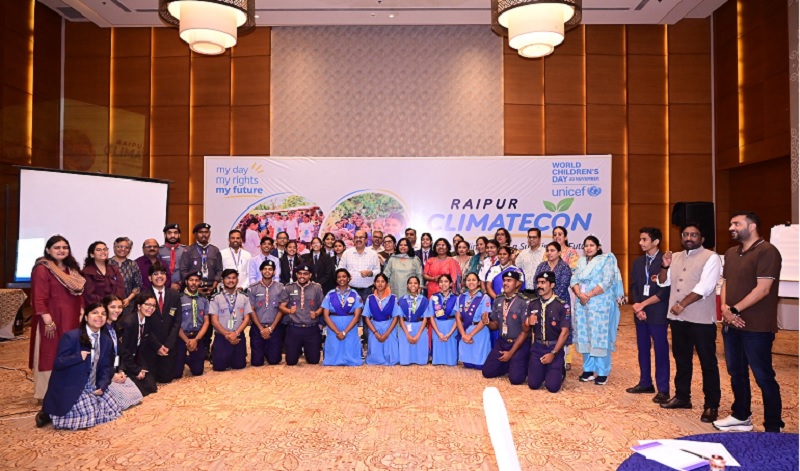
RAIPUR: From saying no to single-use plastic and conserving water and electricity to reusing waste and planting a tree on birthdays, children and young people put forward practical ideas for climate action at Raipur ClimateCon 2026.
The event organised by UNICEF Chhattisgarh in collaboration with Bharat Scouts and Guides and some schools of Chhattisgarh ahead of World Children’s Day on 20 Novembe.
The interactive event brought together around 60 children and young people to share their experiences, concerns and solutions on climate change and explore how it affects their rights, health, nutrition, education and well-being.
Participants included members of Bharat Scouts and Guides from Sarangarh-Bilaigarh, Raipur, Bilaspur, Kabirdham, Baloda Bazar, Mahasamund and Mungeli, along with students from PM SHRI schools and other schools in and around Raipur.
Speaking at the event, Seema Kumar, Chief, UNICEF Chhattisgarh, said: “ClimateCon was an inspiring opportunity to hear directly from children and young people about the climate action they are taking and the ideas they have for change. Their actions remind us that even small steps can lead to meaningful impact.”
“Climate change is not just an environmental issue; it is a child rights issue. It affects children’s health, nutrition, education, safety and well-being. Children and young people must be recognised not only as beneficiaries of climate action, but as partners and changemakers. Their voices, ideas and lived experiences should help shape climate decisions and solutions, from communities and districts to the State level.”
In the opening session Anil Gulati, Communication Specialist UNICEF Chhattisgarh, highlighted the significance of World Children’s Day and its 2026 message, “My Day, My Rights, My Future.” Children and young people were encouraged by him to speak about the climate challenges they see around them, how these affect their lives and communities, and the solutions they believe can make a difference. It’s your day for your rights and your future, so do share, he added.
An activity-based session on “Climate Action: Youth as Changemakers” explored how young people can drive environmental awareness and sustainable practices was done by Biraja Kabisatpathy, WASH Officer, UNICEF
This was followed by an interactive discussion on climate action, child health and nutrition, examining the impact of climate change on children’s health and nutritional well-being and the role of informed choices and community action Dr Gajendra Singh, Health Specialist, and Dr Aparna Deshpande, Nutrition Specialist, UNICEF.
From climate challenges to youth-led solutions
During group work, participants identified climate-related challenges in their communities and collectively developed possible solutions. They then presented their recommendations, demonstrating how children and young people can contribute practical ideas to climate action.
This was facilitated by Sweta Patnaik, WASH Specialist, UNICEF, and Ravi Raj Dayal, Education Specialist, UNICEF.
The presentations were heard by Seema Kumar, Chief, UNICEF Chhattisgarh; representatives of Bharat Scouts and Guides; and Rajesh John Paul, Principal Correspondent, Dainik Bhaskar, Chhattisgarh.
Representatives from Bharat Scouts and Guides included Ashok Deshmukh, State Commissioner; Amit Kumar, State Secretary; Dr Poonam Singh Sahu, State Training Commissioner; and Dilip Patel, State Coordinator.
Raipur ClimateCon 2026 reinforced the importance of meaningful participation of children and young people in climate action, providing them with a platform to learn, collaborate, question and propose solutions.
Anchored in the World Children’s Day message “My Day, My Rights, My Future,” the event underscored a simple principle: children are among those most affected by climate change, and they must have a meaningful voice in shaping the decisions that affect their lives and their future.
Children propose practical climate solutions
Rather than only discussing the challenges posed by climate change, children and young people presented actions that individuals, schools and communities can take. Their suggestions included:
- Saying no to single-use plastic and building the habit at community level.
- Switching off unused electrical appliances and water taps to conserve electricity and water.
- Reducing, reusing and recycling waste, with greater emphasis on reuse rather than disposal.
- Exploring the responsible and strategic use of artificial intelligence, recognising that digital technologies also consume energy and water.
- Creating a “Kachra Library”, where useful items that might otherwise be discarded can be shared and reused by others.
- Encouraging
children and families to plant and nurture a tree on birthdays.