
Special Correspondent
NewsBits.in
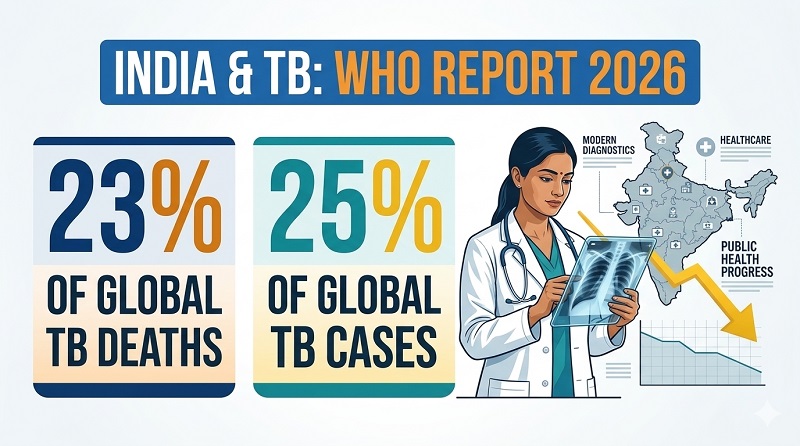
BHOPAL: Despite official claims of rapid progress toward elimination, India continues to bear the world’s highest tuberculosis (TB) burden, accounting for roughly 25% of global TB cases and 23% of global TB deaths, a Jan Swasthya Abhiyan India (JSAI) statement has said.
The statement of the public health movement platform comes with reference to the World Health Organization (WHO) Global Tuberculosis Report 2026, released on November 12, 2026. JSAI said that the report underscores the continuing devastating burden of tuberculosis (TB) in India.
According to the report, 1.13 million people died of TB globally in 2025. India recorded 2.63 lakh TB-related deaths and 25.3 lakh notified cases in 2025 (down marginally from 26.18 lakh cases and over 3 lakh deaths in 2024). Losing more than 2.6 lakh lives in a single year to a preventable and curable disease represents an ongoing public health emergency, the JSAI said.
While the Union Ministry of Health and Family Welfare has highlighted a 38% decline in estimated TB mortality between 2015 and 2025 (from 28 to 18 deaths per lakh population)—meeting the WHO’s interim 2020 End TB milestone five years behind schedule—and a 94% treatment success rate for drug-susceptible TB, these headline figures must not obscure the massive scale of suffering and mortality that persists, the statement added.
‘Lack of Transparency and Missing Incidence Data’
Significantly, the WHO has omitted India’s 2025 TB incidence estimates from this year’s report, placing them under review pending technical calibration of a population-level sentinel survey conducted across 50 representative districts in 2025.
Furthermore, the Government of India has yet to release its own annual India TB Report—traditionally published every March around World TB Day—which provides critical state- and district-level disaggregation.
Without transparent publication of raw epidemiological data and independent scientific scrutiny, official narratives of imminent "TB elimination" remain premature and unverifiable, JSAI said.
‘Alarming Gaps in Drug-Resistant TB Care’
The WHO report identifies India among the countries with the widest gaps between the estimated number of people developing drug-resistant TB and those actually initiated on treatment—recording the largest treatment gap globally for rifampicin-resistant TB (RR-TB).
Globally, only 42% of people estimated to have developed RR-TB received treatment in 2025. In India, delays in universal drug-susceptibility testing, shortages of second-line diagnostics at peripheral centres, and gaps in treatment continuity continue to fuel transmission and preventable deaths.
‘Malnutrition, Poverty, and Occupational Hazards Drive the Epidemic’
TB in India is fundamentally a disease of poverty, under-nutrition, and unsafe working conditions. Globally, WHO estimates that 9.6 lakh new TB cases in 2025 were directly attributable to under-nutrition.
In India, where under-nutrition remains the single largest risk factor for TB, the majority of patients belong to economically vulnerable sections, including daily-wage earners, informal workers, tribal, Dalit, and migrant households. Many cannot afford adequate nutritious food during treatment. Loss of wages, indebtedness and additional expenses further worsen their situation, the statement added.
While the government provides ₹1,000 per month under the Ni-kshay Poshan Yojana—supplemented by voluntary Ni-kshay Mitra food baskets—this amount remains inadequate to meet the high-protein nutritional needs of a patient, let alone protect vulnerable household contacts from infection.
Delays in Direct Benefit Transfers (DBT) and reliance on uneven charitable contributions cannot substitute for guaranteed, universal nutritional and social security.
Gourang Mohapatra and Amulya Nidhi of the JSA India also flagged the widespread diagnostic neglect of silicosis and other occupational lung diseases among workers in mining, stone quarrying, construction, foundries, and brick kilns. Silicosis dramatically increases the risk of TB ("silico-tuberculosis") and is frequently misdiagnosed as pulmonary TB alone.
Treating workers solely with anti-TB drugs without occupational screening denies them early detection, appropriate clinical management, and statutory workers' compensation.
Preventing Catastrophic Out-of-Pocket Expenditure
The WHO report notes that 47% of TB-affected households across surveyed high-burden countries face catastrophic costs—defined as medical expenses, non-medical costs (such as travel and food), and lost wages exceeding 20% of annual household income.
Even though TB drugs are free in India's public sector, out-of-pocket spending prior to diagnosis, private-sector consultations, and prolonged loss of daily wages routinely push working-class families into debt and destitution.
Amitava Guha and Mehjabin bhat of the JSA have said that Tuberculosis is a barometer of social justice. India cannot eliminate TB while millions remain undernourished, underpaid, and exposed to hazardous workplaces. Saving the 2.63 lakh lives lost every year requires decisive action on the social and economic determinants of health.
(Image is AI generated illustration)