
Shams Ur Rehman Alavi
NewsBits.in
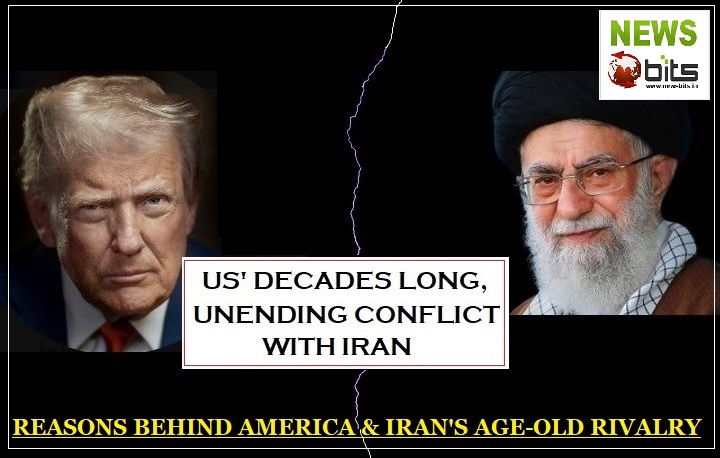
For more than 45 years, the two countries—US and Iran have been adversaries. America is a super power and it seems obsessed with Iran. America constantly issues statements, applies sanctions and focuses on different ways to corner Iran.
Rhetoric, propaganda and coup attempts are also part of this exercise.
There are other countries too that have nuclear programs and there are authoritarian nations that are allies of USA. Also, countries that don’t do well on human rights and are known to crush dissent, exist in different parts of the world.
But regarding Iran, US’ obsessive focus & wish for a regime change is at another level. The strategic reasons, regional dominance in Middle East & other aims, are behind this bitter and old feud.
Actually, US’ age-old conflict with Iran is not just due to US' differences over certain issues or the super power’s wish to promote democracy & promote human rights.
Rather, it is a mix of geopolitics, strategic interests and aim to strengthen its influence in Arab world, especially, because US is a global super power and Iran's stand & independent policy (or defiance) don't suit the American scheme of things—in the US-led global order.
Several monarchies in Middle East are US‘ allies. Hence, the authoritarian rule or lack of democratic values doesn't bother America. US has its military bases in those Arab nations.
However, Iran's case is altogether different, as it is seen as an adversary with ambitions to establish its own influence in the region.
Iran is a large country and it has its proxies in different countries in the region viz. Hezbollah, Houthis & Hamas. It is seen as a country that can counter Israel, which is America's strongest ally & partner. Tel Aviv has relations with a host of Arab countries and it is also able to hold sway over them.
But, Iran is a problem for Israel, as it is a strong country and the recent Iran-Israel war has demonstrated Iran's military prowess. It has become clear that Israel can handle other nations but it needs US' support to keep Iran off.
This is a situation that is not in favour of United States, the super power that wants to maintain its dominance in the region. Iran kept repeating that its nuclear program was for peaceful purposes but there was more strong reaction to it, compared to the silence over Israel’s nuclear program.
The reasons are clear. US-led world order has a condition and it is about having countries aligned to it. If a country pursues a different course and follows a policy that challenges the US’ vision of the world, then it is seen as a move against the American interests.
There are regimes that are repressive or autocratic, but they are tolerated as they cooperate with America in all aspects—militarily as well as economically.
Iran remains a tough nut to crack. It has been a critic of America and despite attempts for regime change, the West has not been successful to enforce a rebellion in the country.
It has also managed to survive despite tough sanctions and open hostility, which is a major factor in the unipolar world. US is well aware that Israel is worried about a nuclear armed Iran. Tel Aviv sees Iran as an existential threat.
The major cause of worry for US is that a nuclear armed Iran would change the balance of power in Middle East, completely. Other countries in the region are dependent on US and buy American weapons, apart from aligning with it.
Iran has allies on the other side viz. China and Russia. Clearly, Iran, a country of nearly 90 million people, which has more population than Britain (70 million), France (69 million) or Germany (80 million), is seen as an adversary. Apart from the strategic importance, the alliances, economic ties and shared interests decide how a country is seen as an ally or an adversary.
TIME LINE
*Iran had nationalized its oil sector in 1951. The decision had angered Britain, which wanted control over oil & saw it as a blow to its economic interests.
*Prime Minister Mohammad Mosaddegh’s government in Iran was toppled, in 1953. The coup was engineered by CIA and MI6 [US-UK’ agencies].
*In 1953, Reza Pahlavi returned to power as the Mosaddegh led regime fell in Tehran. During Shah’s authoritarian rule, Iran remained a strong US ally.
*In 1979, Shah’s government was overthrown. After Khomeini’s return & the Islamic revolution in Iran, there was an end of formal diplomatic relations between US and Iran.